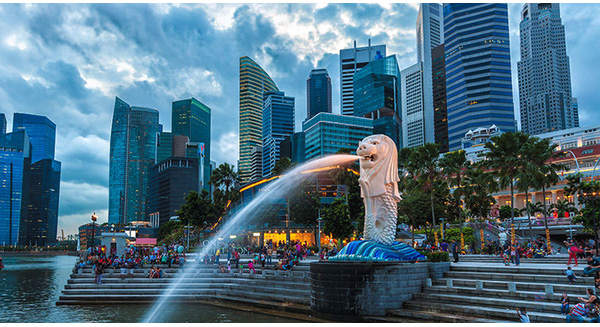

Each nation has their own different approaches to the fourth industrial revolution, Singapore has basically known to how to take their advantages, opportunities to approach the industrial development in their own way.
Singapore is one of many nations around the world to soon announce a program related to The fourth industrial revolution.
Despite Singapore is an island nation with a limited area and its economy mostly depends on services. Singapore is aware of the importance of the processing, manufacturing industry in promoting innovation, thence to replicate such ideas to other industries.
In Singapore’s economic structure, the processing and manufacturing industry maintains at 20 %. Singapore’s fourth industrial revolution program focuses on developing the future factory, enterprise and value chain models based on the fourth industrial revolution, using the outstanding technologies of the fourth industrial revolution, including the combination of production technology with information technology, in the manufacturing industry, advanced materials, additive manufacturing (3D printing), robotics and automation. The future factory model is researched for Singapore’s key industrial sectors, including chemicals, electronics, pharmaceuticals, precision mechanics, automotive mechanics…
Singapore’s fourth industrial revolution program aims at improving the corporate capacity of new technology absorption and the domestic industry via three strategies of technology capacity improvement, digital transformation at the industry and enterprise level, and human resource development.
To have these strategies carried out effectively, Singapore has established a tripartite cooperation mechanism for the strategies with the participation of public organizations, enterprises and universities. Nayang University is an official member involved in formulating and implementing the strategies on technological capacity and human resource development.
Singapore’s industrialization experience
Singapore’s industrial policy may be summarized with several key features as follows: the state’s strong intervention to promote industrialization; strengthen restructuring of the economy and a few priority areas; attract the resources based on free trade and foreign direct investment; invest in infrastructure and human resources to improve production supply; maintain a stable business environment and industry relations; use fiscal stimulus tools to reduce the cost burden on enterprises.
Since the early 1960s, Singapore has successfully transformed from the role of a British cargo port and military base into a regional industrial and service hub. In the 1960s, industry accounted for only 12% of GDP and focused on the activities related to raw material processing and military logistics.
In the period of 1959-1965, Singapore’s Government adopted the import substitution industrialization strategy which aims at providing the new economic pillar, strengthening its role as a trade transshipment port while creating jobs for the rapidly growing workforce. Singapore’s industrialization plan in the early 1960s was mostly based on the Survey Report of the United Nations Delegation on Industry. The Delegation’s report lists the economically viable industries in shipbuilding and repair, metal engineering, chemicals, electrical equipment as well as industrial park development plans, economic, organizational and operational measures to promote the production of developing priority industries.
The report content also recommends that Singapore Government should continue to protect production to several industries and adopt the policies to encourage the domestic manufacturing sector to participate in the industrialization process. The government must directly invest in the fields in which foreign investors or private domestic enterprises do not engage.
With a small size (population of 2 million at the time of separation from Malaysia in 1965), Singapore did not choose the protection policy of the nascent industries because it was a policy choice that required so many resources. Instead, the nation chose a free trade mechanism as the foundation for the industrialization process; Therefore, the process of making and implementing Singapore’s industrial policy is very different from that of other East Asian countries.
In addition, there are almost no domestic enterprises with strong enough industrial production capacity at the starting point, Singapore government decided to work closely with the transnational companies at the very beginning period of the industrialization process. As a result, Singapore has the highest percentage of FDI in total economic investment in the whole world, even higher than the fully free economy like Hong Kong.
However, this does not mean that Singapore is pursuing an industrial policy that completely trusts in the market movements, but on the contrary, in the fields considered to be important, determines the national competitiveness, Singapore government established the state-owned enterprises (SOEs) operating and restricting the participation of the multinational corporations.
Singapore Airlines is a very successful state-owned enterprise, along with such other industries as shipbuilding and telecommunications which are also assumed and played a leading role by SOEs, resulting in Singapore’s big size SOE sector in the world in terms of the economy ratio. If from 1970 to 1990, the public sector’s market share of total fixed capital in Korea was about 10%, the corresponding figure in Singapore was more than 30-36% in the 1960s, 27 % in 1970, and 30% in 1980. In other words, Singapore’s industrial picture feature is the big companies or the branches of multinational corporations or state-owned companies.
If in the period of 1971-1990, Singapore focused on upgrading the industrial sector, along with tax, financial incentives, in order to become an investment destination for exporting multinational corporations, the 1991 period marked Singapore Strategic Economic Development Plan with a 30-year vision. This strategy positions Singapore within the next 20-30 years to become a regional and global business and manufacturing hub, with the two main drivers of growth which are high-tech manufacturing, high added value and services.
Upon the adoption of an industry policy friendly to multinationals does not mean that Singapore permits the transnational companies to decide which sectors to invest in; instead Singapore government has targeted FDI in the industrial sectors that are important for enhancing national competitiveness by investing the favorable conditions in terms of human resources and infrastructure as well as providing financial incentives.
Source: Vietnam Ministry of Industry and Trade